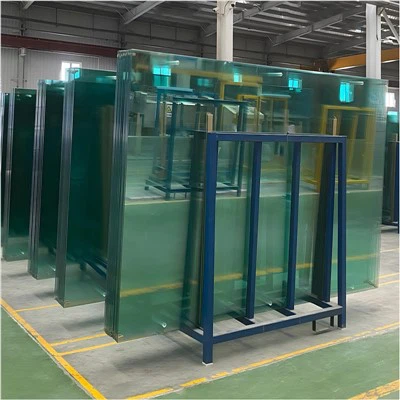
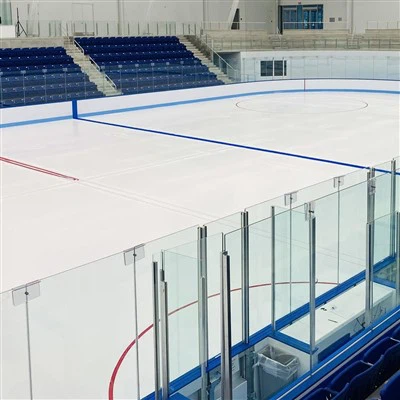
Glass selection for Padel courts (such as fences, spectator stands and other scenarios) is crucial for safety and service life. Tempered glass and laminated glass are mainstream options, but they differ in performance and application scenarios. This article will analyze the differences between the two and the selection logic.


1. Impact Resistance: Core Test for Padel Impact Scenarios
In professional Padel matches, the ball speed exceeds 130 km/h, so impact resistance is a key indicator. Tempered glass has a compressive strength of 120 MPa and can withstand training-level impacts. However, it is prone to breaking when its edges or corners are struck, but the fragments are safe obtuse-angled particles.
Laminated glass is composed of glass and PVB film and will not splinter-fragments will adhere to the film. It can resist professional Padel match-level impacts without the risk of secondary injuries, and its protective performance is superior to that of tempered glass.
2. Safety: Dual Protection for Players and Spectators
Tempered glass fragments are obtuse-angled, meeting basic safety requirements and suitable for scenarios such as low spectator stands and partitions. However, its structure fails after breaking, posing risks when used at height.
Laminated glass can still bear weight after damage (>=100 kg/m²). It is suitable for scenarios such as high-altitude fences and Padel batting zones, which can prevent falling and ball penetration and meet professional Padel standards.
3. Durability and Maintenance: Cost Considerations for Long-Term Venue Operation
Tempered glass: UV-resistant, with a service life of 15-20 years, high hardness (Mohs hardness 6.5), and easy to maintain. It has a 0.3‰ self-explosion risk and requires regular inspection.
Laminated glass has a service life comparable to that of tempered glass and is easy to clean. Core advantage: no emergency replacement is needed after damage. Choosing high-quality PVB film can prevent yellowing.
1. Core Impact Areas: Laminated Glass is Preferred
Laminated glass must be used in core areas such as Padel batting zones and serving zones. Standard specification: "5mm+0.76mm PVB+5mm" (compliant with professional Padel standards). Professional match venues can be upgraded to "6mm+1.14mm PVB+6mm" to improve impact resistance.
2. Non-Core Protection Areas: Tempered Glass Offers Better Cost-Effectiveness
8-12mm tempered glass is suitable for scenarios such as low spectator stands (<=1.2m) and partitions, with high cost-effectiveness. It needs to be chamfered, and homogenization treatment is required for outdoor use to reduce the risk of self-explosion.
The price of laminated glass is 30%-50% higher than that of tempered glass of the same thickness, but its whole-life cycle cost is more advantageous because no emergency venue closure is required.
Procurement key points: 1. Request 3C certification and film test report; 2. Confirm parameters such as thickness and chamfering; 3. Clarify installation standards.
The core of Padel court glass selection: "Safety first, scenario adaptation". Use laminated glass in core areas and tempered glass in non-core areas to balance safety and cost.
If you have needs for Padel court glass procurement or renovation, please feel free to send a private message to obtain a customized plan.